


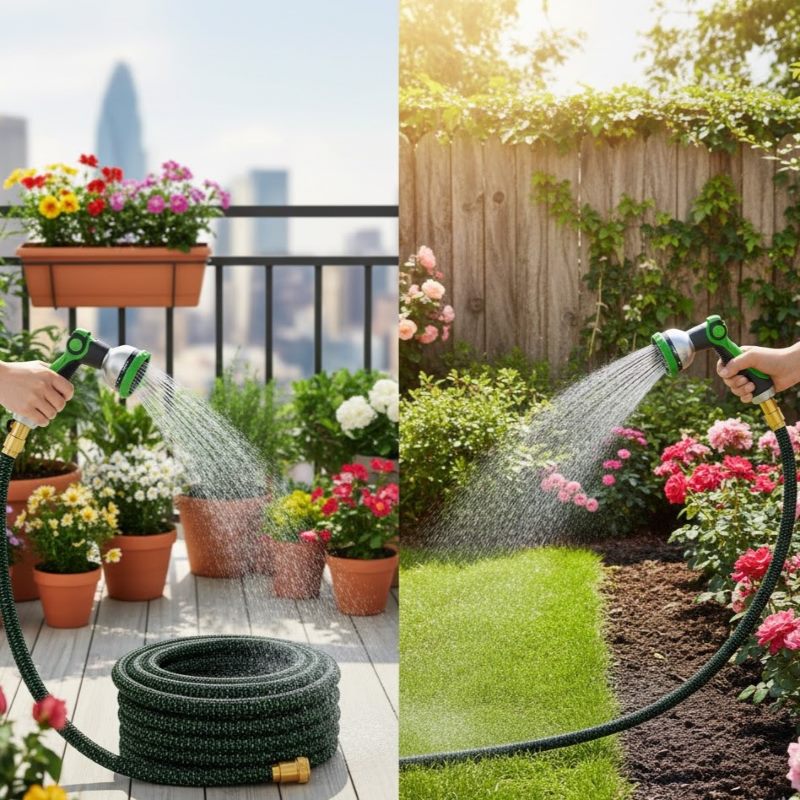
The modern gardener is no longer defined by the acreage they own. Whether it is a curated collection of succulents on a 15th-floor high-rise balcony or a sprawling suburban landscape featuring fruit trees and manicured lawns, the fundamental challenge remains the same: efficient, reliable, and effortless water delivery.
In this quest for the perfect irrigation tool, the expandable garden hoses have emerged not just as a convenience but as a technological marvel that “conquers” every scene it touches. By blending the physics of elasticity with advanced material science, these hoses have solved the age-old frustrations of heavy, kinking, and leaking traditional rubber pipes.
I. The Philosophy of “Softness Overcoming Strength”
Traditional PVC or rubber hoses are the “dinosaurs” of the garden. They are heavy, rigid, and prone to “memory” kinking—where the hose stubbornly maintains its coiled shape, fighting the user at every turn.
The expandable garden hose operates on a principle of dynamic adaptability.
-
The Resting State: When the water is off, the hose is a fraction of its functional length, lightweight enough to be held in one hand.
-
The Active State: Under water pressure, the inner core expands, and the outer fabric jacket stretches, allowing the hose to grow up to three times its original length.
This “softness” allows it to navigate around delicate terracotta pots on a balcony without knocking them over, yet it possesses the “strength” to withstand high water pressures required for deep-soil irrigation.
II. Scenario One: The Urban Balcony – Efficiency in Small Spaces
Urban gardening is a game of inches. When your “garden” is a three-meter strip of concrete, storage is your greatest enemy.
1. Minimalist Storage
A standard 50-foot rubber hose is a nightmare for an apartment dweller. It requires a bulky reel and leaves an unsightly, dripping mess. An expandable hose, however, can be tucked into a decorative ceramic pot or hung on a small hook. Once the water is drained, it “shrinks” back to a manageable size, maintaining the aesthetic integrity of a modern living space.
2. Gentle Precision
Balcony plants are often in containers. High-velocity water streams can wash away expensive potting soil. The flexibility of an expandable hose allows the gardener to maneuver the nozzle with surgical precision, delivering water directly to the roots without the hose itself dragging across and damaging fragile foliage.
III. Scenario Two: The Suburban Yard – Scaling Up Without the Weight
As we move from the balcony to the backyard, the demands on irrigation equipment shift toward reach and durability.
1. The Death of the Kink
Anyone who has spent a Saturday morning washing a car or watering a lawn knows the frustration of a hose kinking 40 feet away, cutting off the water flow. The dual-layer construction of expandable hoses—typically a high-elasticity latex or TPE core protected by a high-denier polyester weave—makes kinking physically impossible. The inner tube is always under tension, keeping the pathway clear.
2. Lightweight Mobility
A 100-foot traditional hose can weigh upwards of 15-20 pounds when filled with water. Dragging that across a large lawn is an unwanted workout. Expandable hoses for irrigation reduce this weight by up to 60%, allowing elderly gardeners or those with limited mobility to maintain large landscapes without physical strain.
IV. The Engineering Excellence: “Resilient Vitality”
What makes a hose “conquer” all scenes? It’s the marriage of two critical components: the Inner Core and the Outer Shield.
1. The Core: The Heart of Expansion
Modern expandable garden hoses utilize multi-layer latex or advanced TPE (Thermoplastic Elastomer). These materials must exhibit high tensile strength.
-
Pressure Resistance: The core must handle standard residential water pressures (typically 40-80 PSI) without bursting.
-
Elastic Memory: It must be able to expand and contract thousands of times without losing its “snap-back” ability.
2. The Outer Fabric: The Armor
The 3750D (denier) polyester fabric is the gold standard. It protects the delicate inner core from:
-
Abrasions: Sharp rocks, thorns, and concrete edges.
-
UV Radiation: Constant sun exposure can degrade plastics; the tightly woven jacket acts as a sunblock.
V. Reliability and Sealing: The Battle Against Leaks
A hose is only as good as its connections. The most common failure point in irrigation is the junction between the hose and the spigot.
1. Solid Brass vs. Plastic
To achieve “all-scenario conquest,” the fittings must be professional-grade. Solid brass connectors are the industry benchmark. Unlike plastic fittings, brass does not crack in the winter or melt in the summer heat. It provides a threaded seal that prevents the “spritzing” leaks that waste water and lower pressure.
2. Built-in Shut-off Valves
A high-quality expandable hose often features a brass shut-off valve at the nozzle end. This allows the user to change spray patterns or move to a different area without walking back to the faucet, providing ultimate control over the irrigation process.
VI. Environmental Impact and Water Conservation
In 2026, irrigation is as much about conservation as it is about growth. Expandable hoses contribute to “Green Living” in several ways:
-
Lower Carbon Footprint: Because they are lighter and more compact, they are more efficient to ship, reducing the overall carbon footprint of the product lifecycle.
-
Zero Leakage: The superior sealing technology ensures that every drop of water reaches the plant, not the pavement.
-
Durability: By moving away from “disposable” PVC hoses that crack after one season, high-quality expandable garden hoses reduce landfill waste.
VII. Maintenance: Ensuring Longevity across Scenarios
To ensure your hose conquers the garden for years to come, a few simple maintenance steps are required:
-
Drain After Use: The “magic” of the contraction happens when water is released. Never leave the hose under pressure when not in use.
-
Avoid Sharp Objects: While the 3750D fabric is tough, it isn’t indestructible. Avoid dragging it over broken glass or jagged metal.
-
Winter Care: In freezing climates, drain the hose completely and store it indoors. Residual water freezing inside the latex core can cause micro-tears.
VIII. Conclusion: The Future of Irrigation is Flexible
The “Conquest of the expandable garden hoses” are testament to how smart design can simplify complex tasks. Removing the physical barriers—weight, bulk, and rigidity—allows the gardener to focus on what truly matters: the health and beauty of their plants.
From the smallest urban balcony to the most expansive rural garden, the expandable hose adapts, performs, and prevails. It is the silent partner in the green revolution, proving that in the world of gardening, flexibility is the ultimate strength.