

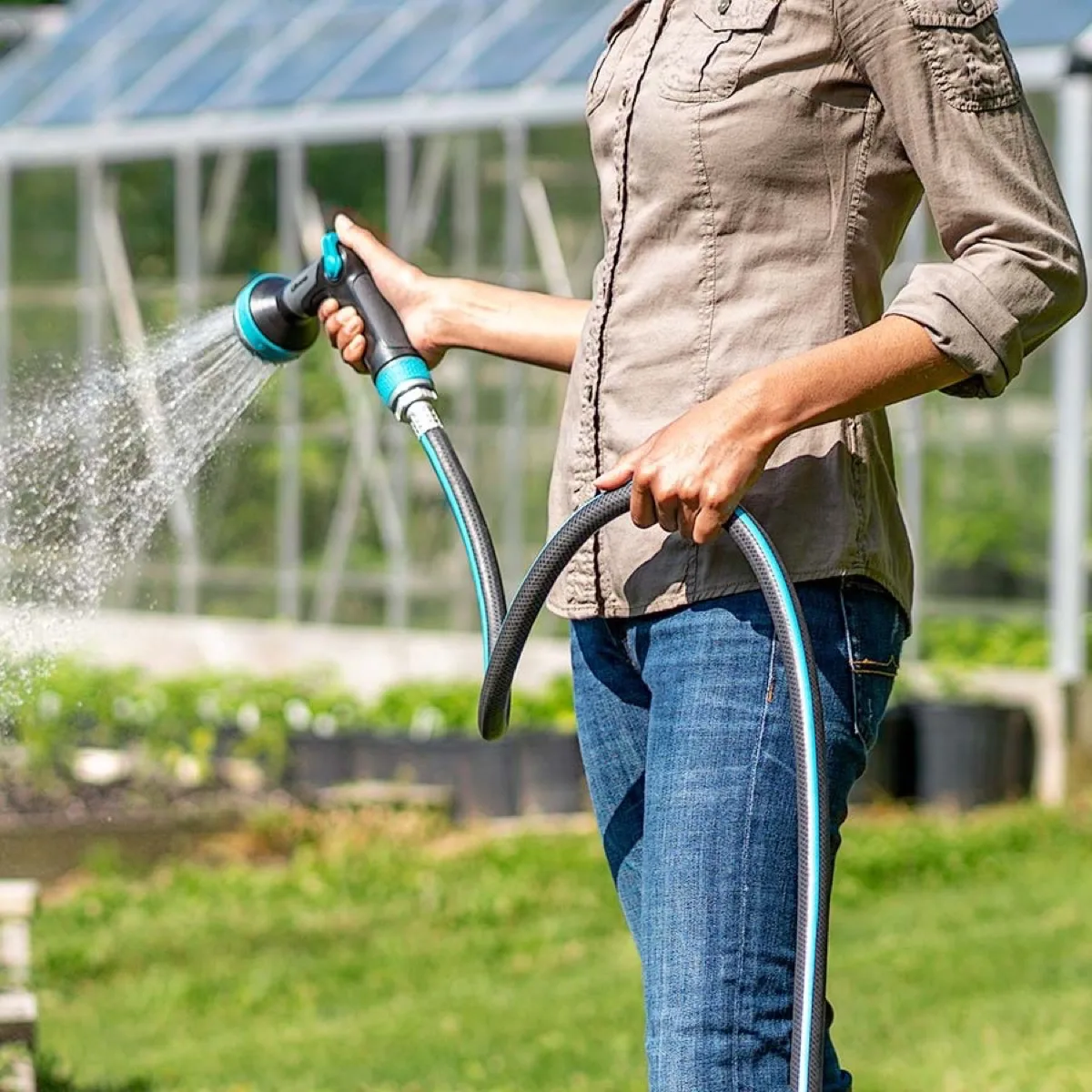
Choosing the right garden hose depends on more than length and price. Different types of garden hoses offer different levels of flexibility, pressure resistance, durability, and storage convenience. A hose designed for a small balcony may not perform well in demanding commercial applications, while a heavy-duty hose may be unnecessarily expensive for occasional residential watering.
For garden hose distributors, importers, and private-label brands, understanding these differences is essential for building a product assortment that meets customer needs and supports sales across different markets.
This guide compares six major garden hose types, explains their advantages and limitations, and helps buyers select suitable products based on climate, water pressure, frequency of use, and storage requirements.
1. Six Major Types of Garden Hoses
1.1 Expandable Garden Hose
An expandable garden hose typically uses a flexible inner tube, often latex or a similar elastomer, with a protective outer fabric layer. When water flows through the hose, it expands under pressure and contracts after the water supply is turned off and the hose is drained.
Its lightweight construction and compact storage make it popular for residential watering.
Best applications:
- Small gardens, balconies, and patios
- Light-to-moderate watering tasks
- Users who prioritize portability and easy storage
- Retail markets focused on convenience-oriented garden products
Advantages:
- Lightweight and easy to carry
- Compact when not in use
- Convenient for users with limited storage space
Limitations:
- Durability varies with tube materials and construction quality
- May be less suitable for sustained high-pressure applications
- Requires appropriate winter storage to reduce cold-weather damage
For distributors, expandable hoses can serve as an entry-level or convenience-focused product. Buyers should check the rated working pressure, connector quality, and expansion-cycle durability before placing bulk orders.
1.2 Stainless Steel Metal Garden Hose
A stainless steel garden hose commonly features a flexible inner tube protected by a metal outer structure. The exact construction varies by manufacturer, so buyers should confirm the inner material, metal grade, and fitting design.
Its protective exterior can improve resistance to external abrasion and punctures compared with some exposed soft hoses.
Best applications:
- Gardens with thorny plants or rough surfaces
- Households concerned about external hose damage
- Buyers looking for a distinctive, durable-looking product
- Outdoor watering applications where surface protection is important
Advantages:
- Protective metal exterior
- Resistance to many common forms of external abrasion
- Flexible handling in designs engineered to reduce kinking
Limitations:
- Weight and flexibility depend on the hose construction
- Metal surfaces can become hot under direct sunlight
- Not every metal hose is fully puncture-proof or chew-proof
When sourcing metal garden hoses, distributors should verify bend radius, connector strength, corrosion resistance, and working-pressure ratings. Products marketed for pet-owning households should be evaluated against realistic bite and puncture conditions rather than assumed to be completely chew-proof.
1.3 Rubber Garden Hose
Rubber garden hoses are made from natural rubber, synthetic rubber, or related elastomer compounds. They are widely used where flexibility, durability, and frequent handling are important.
Depending on the compound and reinforcement, rubber hoses can offer good resistance to temperature changes, kinking, and repeated use.
Best applications:
- Frequent residential watering
- Professional landscaping and grounds maintenance
- Markets with significant seasonal temperature changes
- Applications requiring a robust, reusable hose
Advantages:
- Durable construction options
- Good flexibility in appropriately formulated compounds
- Suitable for repeated handling and demanding outdoor use
Limitations:
- Often heavier than lightweight alternatives
- May cost more than basic residential hoses
- Cold-weather flexibility varies by material formulation
For B2B procurement, rubber hoses are worth considering for mid-range and premium product lines. Buyers should compare material composition, reinforcement, temperature ratings, working pressure, and expected service conditions rather than relying on material type alone.
1.4 Fabric-Braided Garden Hose
Fabric-braided hoses use a textile outer layer over an inner tube or core. This construction can provide a soft, flexible feel and help reduce the bulky handling associated with some traditional hoses.
The actual pressure capacity and service life depend on the inner tube, textile structure, and overall manufacturing quality.
Best applications:
- Light residential watering
- Patios, balconies, and small gardens
- Users who value easy handling
- Retail channels targeting convenient gardening products
Advantages:
- Lightweight and flexible designs
- Convenient handling for everyday watering
- Often easier to store than heavy-duty hoses
Limitations:
- Pressure ratings vary considerably by construction
- Not all models are suitable for high-flow or commercial use
- Outer fabric condition and inner-tube quality affect long-term performance
Distributors should compare the rated pressure, leakage resistance, abrasion performance, and connector durability before positioning fabric-braided hoses for specific applications.
1.5 Flat and Coil Garden Hoses
Flat garden hoses collapse when not in use, while coil hoses are designed to return to a compact shape after use. Although their structures differ, both can appeal to customers who prioritize space-saving storage.
Best applications:
- RV travel and camping
- Small gardens and balconies
- Seasonal watering
- Storage-limited households
Advantages:
- Compact storage
- Convenient transport for selected models
- Useful for temporary or occasional watering tasks
Limitations:
- Flow and pressure performance depend on hose design and diameter
- Flat hoses may twist or fold if handled incorrectly
- Coil hoses may have limited reach or require more effort to position
For RV and camping product lines, buyers should confirm the intended water-use application, hose length, internal diameter, fitting compatibility, and potable-water suitability where drinking-water contact is intended. Compact storage should not replace checks for pressure and material compliance.
1.6 Heavy-Duty and Commercial Garden Hoses
Heavy-duty garden hoses generally feature thicker walls, reinforced construction, or materials selected for demanding operating conditions. They are designed for frequent use and applications where durability and pressure performance are important.
Best applications:
- Professional landscaping
- Grounds maintenance
- Commercial outdoor cleaning
- Frequent watering over long distances
- Applications requiring higher specified working pressures
Advantages:
- Robust construction options
- Suitable for frequent handling
- Reinforced designs may provide higher pressure ratings
- Available in configurations for demanding applications
Limitations:
- Usually heavier and less compact
- Higher purchase cost for many models
- May be unnecessary for occasional residential watering
For professional and commercial buyers, selection should be based on the required working pressure, burst-pressure rating, hose diameter, length, reinforcement, fittings, and operating environment. A heavy-duty label alone does not establish suitability for a particular pressure system.
2. Garden Hose Comparison: Climate, Pressure, and Usage
The following matrix provides an initial screening guide. Actual performance depends on material formulation, reinforcement, fittings, product specifications, and operating conditions.
| Selection factor | Expandable | Metal | Rubber | Fabric-braided | Flat / coil | Heavy-duty |
|---|---|---|---|---|---|---|
| Lightweight handling | Excellent | Varies | Limited | Excellent | Good | Limited |
| Compact storage | Excellent | Good | Limited | Good | Excellent | Limited |
| Frequent daily use | Model-dependent | Model-dependent | Often suitable | Model-dependent | Model-dependent | Often suitable |
| High-pressure applications | Check rating | Check rating | Check rating | Check rating | Check rating | Check rating |
| Cold-weather use | Requires care | Check specification | Compound-dependent | Check specification | Check specification | Material-dependent |
| Hot, sunny environments | Check material | Surface may heat up | Compound-dependent | Check material | Check material | Material-dependent |
| External abrasion protection | Limited to moderate | Often strong | Varies | Varies | Varies | Reinforcement-dependent |
| RV and camping storage | Good | Varies | Less compact | Good | Often suitable | Usually less convenient |
| Professional landscaping | Usually limited | Application-dependent | Often suitable | Application-dependent | Usually limited | Often suitable |
Important: No hose type is automatically suitable for every climate or pressure level. Before ordering, compare the manufacturer’s documented working pressure, temperature range, material compatibility, and intended application.
3. How to Choose a Garden Hose by Application
For Small Gardens and Balconies
Expandable and fabric-braided hoses are practical options when lightweight handling and compact storage matter most. Flat or coil hoses may also work well where storage space is limited.
For this customer segment, distributors can prioritize portability, convenient connectors, simple storage, and clear product instructions.
For Cold Climates
Rubber hoses formulated for low-temperature flexibility may be a suitable choice for colder regions. However, performance varies by compound and product specification.
No standard garden hose should be assumed to withstand freezing water. Before winter, drain the hose and store it according to the manufacturer’s instructions. Buyers serving cold-climate markets should verify the specified minimum operating and storage temperatures.
For High Water Pressure and Frequent Use
Heavy-duty reinforced hoses and suitable rubber hose models are worth evaluating for demanding applications. The final choice should be based on the system’s actual pressure requirements and the hose’s documented working-pressure rating.
Buyers should distinguish working pressure from burst pressure. Burst pressure indicates failure resistance under specified test conditions; it is not the recommended continuous operating pressure.
For Pet-Owning Households
Metal-sheathed hoses may offer improved protection against certain external damage. However, bite resistance depends on the complete construction, including the inner tube, outer structure, and fittings.
For product claims such as chew-resistant or puncture-resistant, distributors should request supporting test information and avoid treating these descriptions as guarantees against all damage.
For RV and Camping
Flat and coil hoses are attractive when packing space is limited. The most appropriate model depends on the water source, connection type, intended flow, and storage conditions.
For drinking-water applications, verify that the hose and all water-contact components are specifically suitable for potable water and comply with the requirements of the destination market.
For Professional Landscaping and Commercial Use
Heavy-duty and appropriately specified rubber hoses can support frequent handling and demanding workloads. Selection should account for hose diameter, required flow, working pressure, total length, abrasion exposure, and fitting compatibility.
A suitable hose should meet the application’s requirements without adding unnecessary weight or cost.
4. Garden Hose Buying Checklist for Distributors and Importers
When sourcing garden hoses for wholesale, OEM, or private-label programs, evaluate more than the initial unit price.
Product specifications
- Hose type, length, and internal diameter
- Inner-tube and outer-layer materials
- Reinforcement structure
- Working-pressure and burst-pressure ratings
- Operating and storage temperature ranges
- Fitting materials and connector compatibility
Quality and durability
- Leakage and pressure testing
- Kink resistance under defined conditions
- Abrasion and puncture performance where relevant
- Connector strength and corrosion resistance
- Consistency between production batches
Market requirements
- Climate and typical end-user applications
- Retail price positioning
- Packaging and labeling requirements
- Potable-water suitability, if applicable
- Destination-market regulatory requirements
OEM and private-label considerations
- Available colors, lengths, and fitting configurations
- Custom packaging and brand presentation
- Product testing and documentation
- Minimum order quantities and production lead times
- Sample approval and quality-control procedures
A structured checklist helps distributors compare suppliers on product performance, compliance, and total sourcing value rather than price alone.
5. Frequently Asked Questions About Garden Hose Types
Which type of garden hose is best for cold climates?
A rubber hose specifically rated for the intended low-temperature conditions can be a strong option. Always check the manufacturer’s temperature specifications and drain the hose before freezing weather to reduce the risk of damage.
Which garden hose is suitable for households with dogs?
A metal-sheathed hose may provide better protection against some external damage. However, not all metal hoses are completely chew-proof. Verify the construction and any supporting durability tests before making a purchasing decision.
What is the best garden hose for RV and camping?
Flat and coil hoses are useful when compact storage is a priority. Confirm fitting compatibility, pressure ratings, required flow, and potable-water suitability if the hose will carry drinking water.
Is a heavy-duty garden hose always better?
No. Heavy-duty hoses are useful for frequent handling and demanding applications, but they can be heavier and more expensive. For occasional watering, a lightweight hose may offer better value.
What should importers check before buying garden hoses in bulk?
Importers should review material specifications, hose dimensions, working pressure, temperature range, fittings, durability tests, packaging options, and quality-control procedures. They should also confirm applicable destination-market requirements.
Conclusion: Match Garden Hose Types to Customer Needs
The six major garden hose types serve different priorities. Expandable and fabric-braided hoses emphasize convenience, metal hoses offer external protection, rubber hoses provide durable options for repeated use, flat and coil hoses save storage space, and heavy-duty hoses target demanding applications.
For distributors and private-label brands, the most effective assortment is not necessarily the one with the most products. It is the one that matches local climate, water pressure, usage frequency, storage requirements, and target price points.
XIANLIN manufactures garden hoses for OEM and private-label programs. Contact our team to discuss product specifications, market positioning, and assortment options for your target customers.