


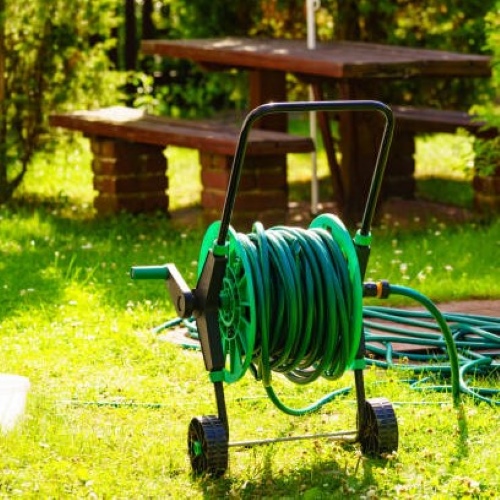
For anyone who has ever turned on an outdoor hose in the peak of July, the experience is all too familiar: the initial burst of water is not refreshing—it is scalding. In the industry, this is often joked about as the “Natural Hot Spring” effect, but for gardeners, pet owners, and outdoor cooling systems, it is a serious problem. Standard black or dark green hoses act as high-efficiency solar collectors, absorbing radiation and heating the stagnant water inside to temperatures that can either damage delicate plants or even cause minor burns.
To solve this, a new generation of UV-resistant PVC garden hoses has emerged, featuring an innovative three-layer composite structure. By integrating high-tech insulation layers, these hoses ensure that the output water temperature remains 3-5°C lower than that of ordinary pipes, even after hours of exposure to direct sunlight. This article explores the science behind this “cooling” technology and why it is a game-changer for modern outdoor water management.
1. The Thermal Trap: Why Traditional Hoses Turn Water into Steam
Traditional water pipes are often designed with a focus on durability and flexibility, but they frequently ignore “thermal conductivity.”
The Solar Absorption Problem
Most standard hoses use dark-colored PVC or rubber. These materials have a high solar absorption coefficient, meaning they convert the sun’s ultraviolet (UV) and infrared radiation into heat energy with alarming efficiency. Within 30 minutes of summer exposure, the surface temperature of a black hose can exceed 60°C (140°F).
The Heat Transfer Chain
Because standard hoses are thin-walled and made of conductive polymers, this surface heat transfers directly to the water sitting inside the pipe. For outdoor misting systems or delicate greenhouse irrigation, this “hot start” can damage sensitive components or shock the root systems of exotic plants. The demand for UV-resistant PVC garden hoses with cooling properties is a direct response to this environmental challenge.
2. The Triple-Layer Architecture: A Shield Against the Sun
The secret to maintaining a lower water temperature lies in the “Triple-Layer Composite” design. Unlike a single-extrusion pipe, these advanced hoses function like a high-tech thermos.
Layer 1: The Outer UV-Protective Shield
The outermost layer utilizes a specialized UV-stabilized PVC compound.
-
The Action: This layer contains reflective pigments and UV absorbers that bounce away a significant portion of solar radiation.
-
The Result: It prevents the pipe from “photodegradation” (becoming brittle or cracking) and serves as the first line of defense against thermal buildup.
Layer 2: The Micro-Porous Foam Insulation (The Core Secret)
This is where the magic happens. The middle layer consists of a high-density, micro-porous foam structure.
-
The Physics: Air is a poor conductor of heat. By trapping millions of microscopic air bubbles within the PVC matrix, this layer creates a “thermal break.”
-
The Benefit: It effectively slows down the conduction of heat from the outer skin to the inner core. This is why the water remains 3-5°C cooler; the heat simply cannot “travel” through the foam barrier before the water is discharged.
Layer 3: The Food-Grade Inner Transport Layer
The innermost layer is made of ultra-smooth, food-grade PVC.
-
The Purpose: It ensures that even if the pipe is warm, no chemicals leach into the water. Its mirror-smooth surface also reduces friction, ensuring maximum flow rate and pressure—essential for high-performance misting systems.
3. Performance Data: The 5°C Difference in the Real World
When we discuss a 3-5°C temperature drop, it might sound small, but in biological and mechanical terms, it is significant.
-
Plant Health: Many plants experience “root shock” if watered with liquid above 30°C. By keeping the water closer to the ambient temperature, the insulated hose protects the plant’s metabolic health.
-
Misting Efficiency: For outdoor cooling fans and misting lines, starting with cooler water allows the evaporative cooling process to be more effective. A lower entry temperature means the mist can drop the surrounding air temperature more rapidly.
-
Structural Longevity: Heat is the primary cause of PVC “weeping” or softening. By maintaining a cooler core, UV-resistant PVC garden hoses retain their structural rigidity (their “burst pressure” rating) much longer than standard pipes.
4. Beyond Temperature: The Durability of UV Resistance
A hose that stays cool but cracks after one summer is not a professional solution. The “UV-Resistant” aspect of these pipes is equally critical for long-term ROI.
Preventing “Polymer Fatigue”
Without UV stabilizers, the sun’s rays break the molecular bonds of the PVC, leading to a yellowing, hardening, and eventual “alligatoring” of the surface. Advanced UV-resistant PVC garden hoses use titanium dioxide and HALS (Hindered Amine Light Stabilizers) to ensure that the pipe remains flexible and vibrant for years, even in high-altitude or desert environments.
Kink Resistance and Flexibility
The triple-layer structure also provides superior mechanical properties. The micro-porous middle layer adds “body” to the pipe, making it much more difficult to kink or collapse around corners, while remaining light enough for easy transport around a large estate or commercial facility.
5. Conclusion: Designing for a Hotter Planet
As global summer temperatures continue to rise, the “standard” water hose is no longer sufficient for professional or high-end residential use. We must move toward systems that understand environmental physics.
The UV-resistant PVC garden hose with an integrated insulation layer is the “Silent Guardian” of the garden. It protects the water, the plants, and the system hardware from the invisible threat of solar radiation. By mastering the “Triple-Layer” architecture, these pipes prove that even a simple tool like a water hose can be a masterpiece of thermal engineering. Don’t let your water pipes suffer from heatstroke—invest in the technology that keeps your cooling system truly cool.