


Global temperature patterns are shifting rapidly. Prolonged heatwaves are no longer rare phenomena but recurring challenges across agricultural and horticultural regions. For nurseries, where delicate seedlings represent both biological and economic investment, heat stress can devastate productivity.
During extreme heat, plants lose water faster than roots can replenish it. Leaf tissues wilt, stomata close, and photosynthesis efficiency collapses. Conventional irrigation systems often fail to address this dynamic imbalance because they prioritize soil moisture rather than canopy microclimate regulation.
To protect young plants from thermal injury, growers are increasingly turning to targeted cooling sprinkler systems. These systems deliver fine, controlled misting to lower leaf-surface temperature and restore evaporative balance. The combination of precision engineering and environmental control positions the cooling sprinkler for nursery plants as a vital tool in sustainable horticultural management.
1. Understanding Plant Heat Stress and Its Physiological Impact
Heat stress occurs when ambient temperatures exceed a plant’s optimal tolerance range. In seedlings and young plants, this limit is particularly narrow. Excessive heat accelerates transpiration and disrupts enzymatic activity within chloroplasts.
As the plant attempts to conserve water, stomata close, restricting CO₂ uptake and halting photosynthesis. Over time, this leads to oxidative stress, cellular damage, and slowed growth. Root zones can also overheat, further impairing nutrient absorption.
Therefore, heat stress is not merely a surface issue—it affects the entire physiological system. Managing it requires a holistic approach that balances temperature, humidity, and soil-water dynamics simultaneously.
2. The Role of Microclimate Control in Nursery Management
Nurseries differ from open-field agriculture because they must maintain consistent microclimatic conditions. The key parameters—temperature, relative humidity, and light intensity—directly influence plant vigor and survival rates.
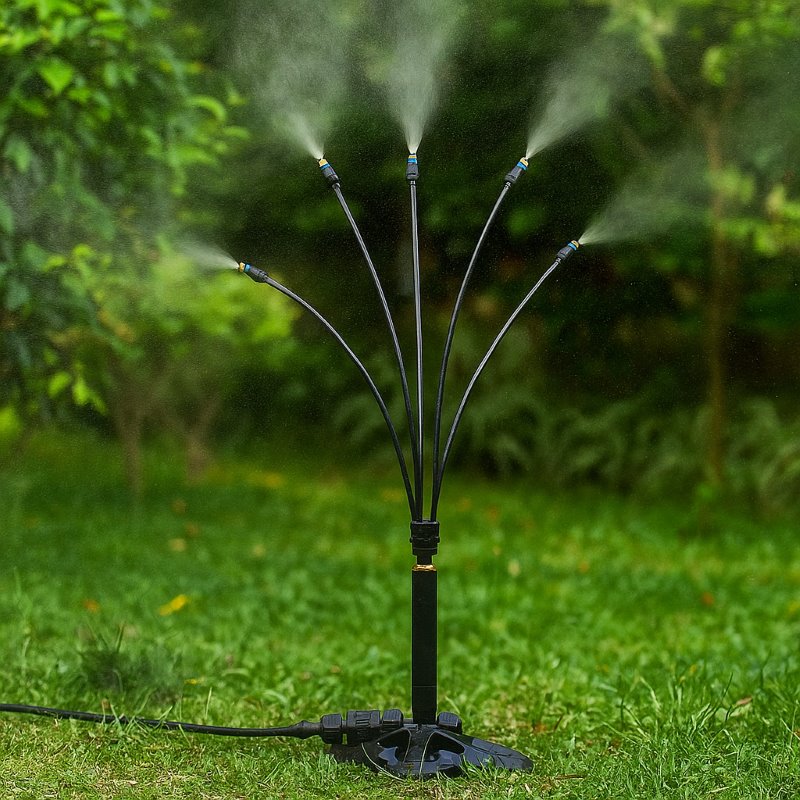
A cooling sprinkler for nursery plants is designed precisely for this purpose. Unlike traditional overhead irrigation, it distributes atomized water droplets in a uniform mist pattern that absorbs latent heat from the air. As these micro-droplets evaporate, they reduce the surrounding air temperature without over-saturating the soil.
This method allows growers to fine-tune the microclimate even during peak sunlight hours. More importantly, it prevents soil waterlogging, which is a common problem in conventional flood irrigation systems.
The ability to stabilize microclimate conditions distinguishes precision cooling sprinklers as a next-generation irrigation technology in horticulture.
3. Engineering Principles of Targeted Cooling Sprinkler Systems
Modern nursery cooling systems are built upon two engineering principles: evaporative cooling and directional spray control.
First, atomization is achieved through high-pressure nozzles that convert water into mist particles between 50–100 microns in diameter. These droplets are small enough to remain airborne, allowing maximum surface-area exposure for heat exchange.
Second, the sprinkler layout ensures coverage uniformity. Adjustable nozzles and oscillating heads enable fine directional control, allowing growers to target specific plant zones or shaded areas.
Some systems also integrate thermosensitive automation, which triggers misting cycles when ambient temperatures exceed preset thresholds. This reactive design reduces energy and water consumption while maintaining constant environmental protection.
In short, targeted cooling sprinklers combine fluid dynamics, sensor technology, and energy efficiency to deliver responsive microclimate regulation.
 4. Comparing Cooling Efficiency Across System Types
Cooling sprinklers can be classified into low-pressure, high-pressure, and fogging systems based on operating pressure and droplet size.
Low-pressure models are economical but produce larger droplets, making them more suitable for general irrigation than microclimate cooling. High-pressure misting systems, however, generate ultra-fine droplets that evaporate quickly and effectively reduce canopy temperature.
Advanced designs combine the two systems through hybrid configurations, delivering both soil moisture and air cooling in coordinated cycles. The result is superior energy efficiency and minimal water loss.
Field data show that nursery environments equipped with high-pressure cooling sprinklers for plants experience up to a 10°C reduction in canopy temperature during midday peaks. This temperature moderation dramatically decreases leaf burn, flower abortion, and overall plant mortality rates.
5. Balancing Evaporation and Hydration
While cooling efficiency is crucial, excessive misting can cause humidity oversaturation. When relative humidity exceeds 90%, plants struggle to transpire effectively, leading to oxygen deficiency at the root level.
To prevent this, modern cooling sprinkler systems incorporate programmable intervals. These short bursts of mist provide rapid cooling followed by recovery periods that restore air exchange.
By maintaining relative humidity between 65–80%, the system supports ideal physiological activity. This controlled alternation between evaporation and hydration ensures both cooling stability and respiratory balance.
In nursery environments, this principle is vital for species such as ferns, orchids, and young ornamentals that require delicate humidity management.
6. The Importance of Nozzle Design and Placement
Nozzle engineering defines both cooling performance and resource efficiency. The optimal design ensures fine mist dispersion with minimal drift. Stainless-steel or ceramic nozzles resist corrosion and maintain consistent orifice dimensions even under high pressure.
Placement geometry also plays a critical role. Sprinklers must be installed at angles that minimize shadow zones and prevent overlapping spray. In curved or tiered nursery layouts, using multi-directional adjustable heads enhances overall uniformity.
Some growers employ zonal control networks, where individual sprinkler lines correspond to specific plant types. This allows differential cooling intensity across the nursery, accommodating the varying thermal sensitivities of distinct species.
Through intelligent nozzle selection and layout design, nurseries achieve efficient water usage while maintaining a stable microclimate for plant growth.
7. Integration with Environmental Monitoring Systems
Precision cooling relies on data. Integrating the cooling sprinkler for nursery plants with environmental monitoring systems transforms irrigation into a smart, adaptive process.
Sensors measure air temperature, humidity, and leaf-surface temperature in real time. The data feeds into programmable logic controllers (PLCs) or IoT-based dashboards that adjust misting frequency automatically.
This real-time adaptability prevents under- or over-cooling, reducing resource waste while maximizing plant resilience. In advanced setups, predictive algorithms anticipate temperature spikes based on weather forecasts, pre-cooling the nursery environment before heatwaves intensify.
The integration of automation and data analytics marks a decisive step toward sustainable horticultural engineering.
 8. Sustainable Water and Energy Management
In water-scarce regions, resource conservation is as important as plant health. Targeted sprinkler systems address this concern by using high atomization efficiency to achieve more cooling with less water.
Each droplet contributes to latent heat removal rather than unnecessary runoff. Additionally, water recirculation systems collect and filter excess mist, returning it to the supply line for reuse.
Energy efficiency is also optimized through low-voltage pump control and solar-assisted power systems. Combined with automated scheduling, these features significantly lower operational costs while reducing the carbon footprint of nursery operations.
This sustainable approach aligns with global trends toward eco-responsible agriculture, where resource use and environmental impact are evaluated simultaneously.
9. Field Applications and Species-Specific Benefits
Cooling sprinklers are not one-size-fits-all devices. Their performance varies across species and climatic conditions.
For vegetable seedlings, cooling systems prevent leaf scorch and improve transplant vigor. Fruit tree nurseries benefit from improved flower retention and reduced fruit drop. Floriculture operations, such as rose or gerbera propagation, rely on consistent humidity to maintain petal quality and stem strength.
Even in ornamental or tropical nurseries, where plant aesthetics dictate commercial value, microclimate stability enhances color saturation and foliage density.
Case studies show that nurseries employing targeted cooling achieved up to 25% higher survival rates during prolonged heat events compared to conventional irrigation. These outcomes validate the system’s critical role in modern horticultural management.
Conclusion: Precision Cooling as a Shield Against Climate Extremes
Heatwaves represent one of the greatest threats to modern plant production. As global temperatures rise, nurseries must adopt proactive climate-control strategies to safeguard their crops.
Targeted cooling sprinkler systems offer more than mechanical irrigation—they embody precision, sustainability, and biological empathy. By managing microclimates intelligently, these systems protect seedlings from irreversible stress, enabling consistent growth even under extreme environmental conditions.
The combination of advanced nozzle design, automated control, and data-driven optimization transforms cooling into an art form—a science of balance between air, water, and life.
For horticulture professionals, embracing this technology is not just an operational upgrade; it is a commitment to sustainable plant health and agricultural resilience.